
Roof leaks rarely begin as dramatic events. More often, water enters through a small weakness around a shingle, flashing joint, vent, or roof edge and gradually spreads into insulation, sheathing, ceilings, or wall cavities. In Boonville, NY, repeated snow, ice, wind, rain, and seasonal temperature swings can make minor roofing defects worse over time.
Understanding the likely source of a leak helps residents respond safely and avoid assuming that the visible ceiling stain marks the exact entry point.
Where do roof leaks most often begin?
Most roof leaks start at openings, transitions, or edges rather than in the middle of an intact roofing surface. Common problem areas include:
- Damaged or missing shingles
- Flashing around chimneys, walls, and roof valleys
- Plumbing vent openings
- Skylights and roof windows
- Ice dams along eaves
- Gutters and roof edges
- Low-slope sections where water drains slowly
- Roof penetrations added for wiring, ventilation, or equipment
Water can travel along roof decking, rafters, insulation, and drywall before becoming visible indoors. A stain near a ceiling corner may therefore originate several feet away, particularly after wind-driven rain or melting snow.
How do damaged or aging shingles cause leaks?
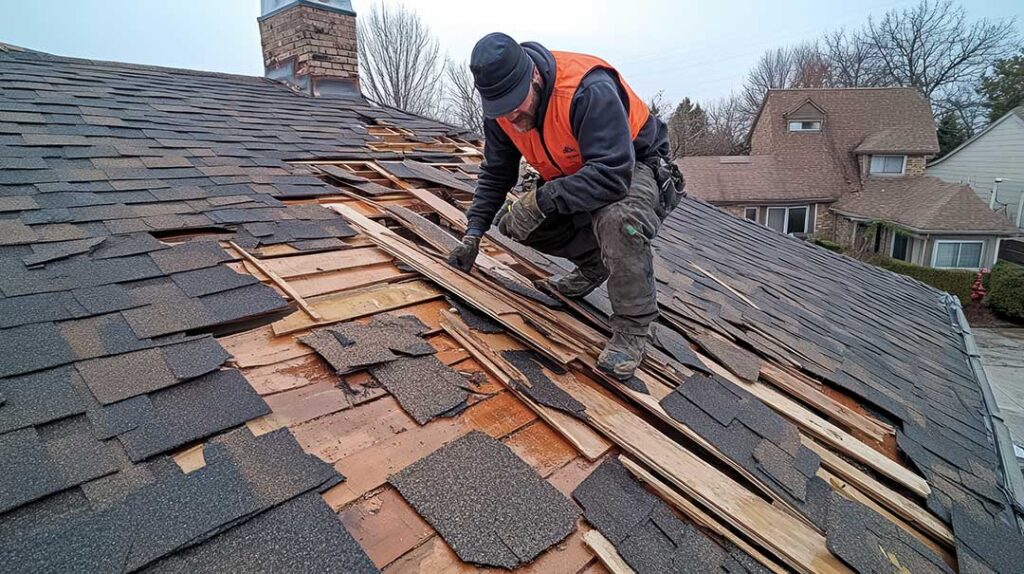
Shingles protect the roof deck from direct exposure to rain and snow. They can leak when they are missing, cracked, curled, lifted, punctured, or worn thin enough that the underlying layers no longer remain reliably dry.
Weather exposure contributes to shingle deterioration. Strong wind can loosen fasteners or lift shingle edges. Hail, falling branches, and foot traffic can create small fractures. Repeated freezing and thawing can enlarge existing damage, especially where water enters a crack and expands as it freezes.
Older roofs may not have a single obvious failure. Instead, granules gradually wear away, adhesive strips lose strength, and the roofing material becomes less flexible. Small defects can then appear around fasteners, seams, and exposed edges.
A ground-level inspection may reveal dark patches, uneven rows, missing pieces, or granules collected near downspouts. Walking on a roof can cause additional damage and is unsafe when surfaces are wet, icy, steep, or weakened.
Why are flashing failures a frequent source of water intrusion?
Flashing is the material used to direct water away from joints and changes in roof direction. It is commonly installed around chimneys, sidewalls, roof valleys, vents, skylights, and dormers. Because these locations interrupt the continuous roof surface, they require careful water management.
Leaks can develop when flashing:
- Pulls away from masonry or siding
- Becomes bent or corroded
- Has failed sealant at a joint
- Was installed incorrectly
- Is covered by roofing material in a way that traps water
- Shifts as nearby materials expand and contract
Chimneys are a frequent example. Water may enter through damaged step flashing, counterflashing, the chimney cap, or cracked masonry above the roofline. The resulting interior stain may appear well away from the chimney because water follows framing before reaching the ceiling.
Sealant alone is not always a permanent repair. If the underlying flashing is loose, poorly shaped, or deteriorated, adding more caulk may only delay the leak.
Can ice dams cause roof leaks in Boonville?
Yes. Ice dams can cause leaks when melting snow flows toward a cold roof edge and refreezes before it drains away. The resulting ridge of ice can hold water against the lower roof area, allowing moisture to move beneath shingles or through vulnerable joints.
Ice dams are more likely when roof heat is uneven. Warm areas above the attic can melt snow while the eaves remain cold. Insufficient attic insulation, air leakage around ceiling penetrations, blocked soffit ventilation, and uneven snow coverage can all contribute.
Ice dams are not caused only by heavy snowfall. A sequence of snow followed by sun, mild temperatures, and refreezing can create the same problem. Water stains near exterior walls, upper-floor ceilings, or roof overhangs after a thaw may indicate this type of intrusion.
Removing ice with sharp tools can damage shingles and create fall hazards. Pouring salt or chemical products on the roof can also harm roofing materials, plants, gutters, and nearby surfaces. Prevention generally depends on managing attic heat and airflow, keeping roof drainage paths clear, and addressing areas where snow repeatedly accumulates.
How do gutters and roof edges contribute to leaks?
Gutters do not usually cause a roof leak by themselves, but blocked or damaged drainage can send water where it does not belong. Leaves, pine needles, ice, and roof debris can obstruct water flow. When gutters overflow, water may run behind the gutter, soak fascia boards, or collect near roof edges.
A sagging gutter can hold standing water and pull away from the fascia. Improperly positioned downspouts can discharge too close to the foundation, while damaged drip edges may allow water to move behind the roof covering and into wood components.
In snowy areas, heavy ice in gutters can deform them or loosen their fasteners. Water may also back up at the eaves during freezing weather. Signs of drainage-related problems include peeling paint on fascia, staining beneath the eaves, damp exterior walls, and water appearing near the edge of an upper-floor ceiling.
Can roof vents and plumbing pipes leak?
Yes. Every pipe, vent, fan, or electrical feature that passes through the roof creates a potential entry point. Plumbing vent boots often deteriorate where rubber or flexible material meets the pipe. The metal flashing beneath the boot may also loosen or corrode.
Bathroom and kitchen exhaust vents can leak if their roof caps are cracked, improperly flashed, or missing a weather-resistant cover. A vent that terminates in the attic instead of outside can add moisture to the attic, although that condition is different from a roof leak and still requires correction.
The location of the indoor stain may provide a clue. A damp area near a bathroom, kitchen, or attic penetration deserves inspection around the corresponding roof feature, but water may still travel before appearing indoors.
What other overlooked causes should homeowners consider?
Some leaks come from conditions that are easy to mistake for roofing failures.
Condensation can form when warm, moist indoor air reaches a cold attic surface. Poor ventilation, unsealed ceiling penetrations, and indoor humidity can produce damp insulation, frost, or water stains that resemble a roof leak. This is especially possible during cold weather.
Roof-mounted equipment, satellite-related penetrations, antennas, and makeshift repairs can also create openings. Branches rubbing against shingles may gradually wear through the surface. Animals can damage ridge vents, soffits, or roofing materials while creating entry points.
A leak may also appear after a roof replacement if old flashing was reused, fasteners were misplaced, or a transition between roof sections was not properly integrated. New stains do not always mean the entire roof surface has failed.
What should be done when a ceiling stain appears?
First, protect people and belongings from falling water or damaged ceiling material. Place a container under active dripping, move furniture, and avoid electrical fixtures or outlets that may have become wet. If water is near electrical equipment, shut off power to the affected area only if doing so is safe.
Document the location and timing of the leak. Note whether it follows rain, wind, snowmelt, or a temperature change. Photographs of the ceiling, attic, and visible exterior damage can help identify patterns.
Do not assume that a dry ceiling means the problem is resolved. Roofing materials and insulation can retain moisture after the visible dripping stops. Persistent dampness can contribute to rot, mold growth, damaged insulation, and weakened framing.
Roof access should be avoided during icy, snowy, wet, or windy conditions. Situations involving active electrical hazards, unstable ceilings, significant structural damage, or unsafe roof access require qualified assistance because the immediate risk may be greater than the leak itself.
How can roof leaks be reduced before they start?
Routine observation helps catch small defects before they become interior damage. From the ground or a safely accessible attic, watch for:
- Missing, lifted, or curled shingles
- Rusted or displaced flashing
- Blocked gutters and downspouts
- Damp insulation or stained roof decking
- Daylight visible around roof penetrations
- Peeling fascia or exterior wall paint
- Repeated ice buildup along the same eave
Keeping attic insulation and ventilation properly balanced can reduce condensation and uneven snowmelt. Clearing drainage paths before winter, trimming branches that overhang the roof, and checking after major wind or snow events are practical maintenance steps for area households.
A roof leak is best understood as a water-path problem, not simply a stain on the ceiling. Finding the entry point, the route water traveled, and the condition that allowed it to enter leads to a more accurate solution than covering the visible mark alone.
